Virus, New Normal,
and Society
By: Paúl Moscoso Riofrío
June, 2020
The following text was reviewed during the last two weeks of May. Its information contains a kind of historical account and an analysis of a current event: the coronavirus. The purpose of publishing this text has been to show the ways individuals think in moments as complex and unstable as the present crisis. At the beginning of June, when the text was finished, it was perhaps the last moment in which we used our time to mono-think. That is to say, the coronavirus and the effects of the pandemic are still the subject of headlines, affecting every space and moment of our lives, but the range of other or further setbacks and events in everyone's lives is perhaps large enough to capture everything—or it is simply no longer momentous for everyday living. Here is the argument:
Virus, New Normal, and Society
Being just a few hours away from the end of social isolation, several doubts arise at first glance. Above all, what a "new normal" will mean, emphatically named so by governments. My two great uncertainties are: How, and what circumstances are needed, for us to feel "normal"? In Ecuador, the start of the social confinement (officially known as social isolation) was ordered on March 17. Since that day, we as people have become beings of the indoors. Going out for a walk or living experiences in the outside world seem like a luxury we cannot afford. Of course, each individual must restrict our freedoms for the sake of everyone's well-being, especially the elderly and people with health complications. I repeat my initial question: if in the future we are to feel "normal," are we willing to reinvent ourselves and accept the opportunities that the present disaster offers? The continuous social contact that we have been growing unaccustomed to over the past weeks has transformed our perception of reality. There is talk of a "new normal," as if pointing to the idea that the world before the pandemic could be considered normal. That is to say, we are going to live under a magnifying glass of a new normal, so all human expressions will be that way too. I wonder what implications it will have for politics, the economy, art, the sciences, religion, etc. The arrival of COVID-19, in the case of my country, came to us when we found ourselves in a distressing mental and material situation. In a certain way, complacent with the ravages of contemporary society. Only now that we find ourselves confined is when we begin to think about what it really means to live in freedom and in normal conditions. I quite like this idea! What I fear most, on the other hand, is a direct consequence of the above: believing ourselves normal in pre-virus life does not mean returning to February 2020. Neither Ecuador nor the entire planet has the minimum ideal living conditions for its inhabitants; after the pandemic passes, it is a task requiring much reflection and sound decisions. What tools do we currently have to inspire a change in our normal while we stay at home?
To begin with, many of us fortunate ones still have our health; the next step is a bit more complicated. Perhaps it would be worth following the trail of positive initiatives that our society is currently demanding. The concept of the circular economy, to give an example, is about keeping services and products in use for longer and generating continuous systems of support. I illustrate this with the following anecdote.
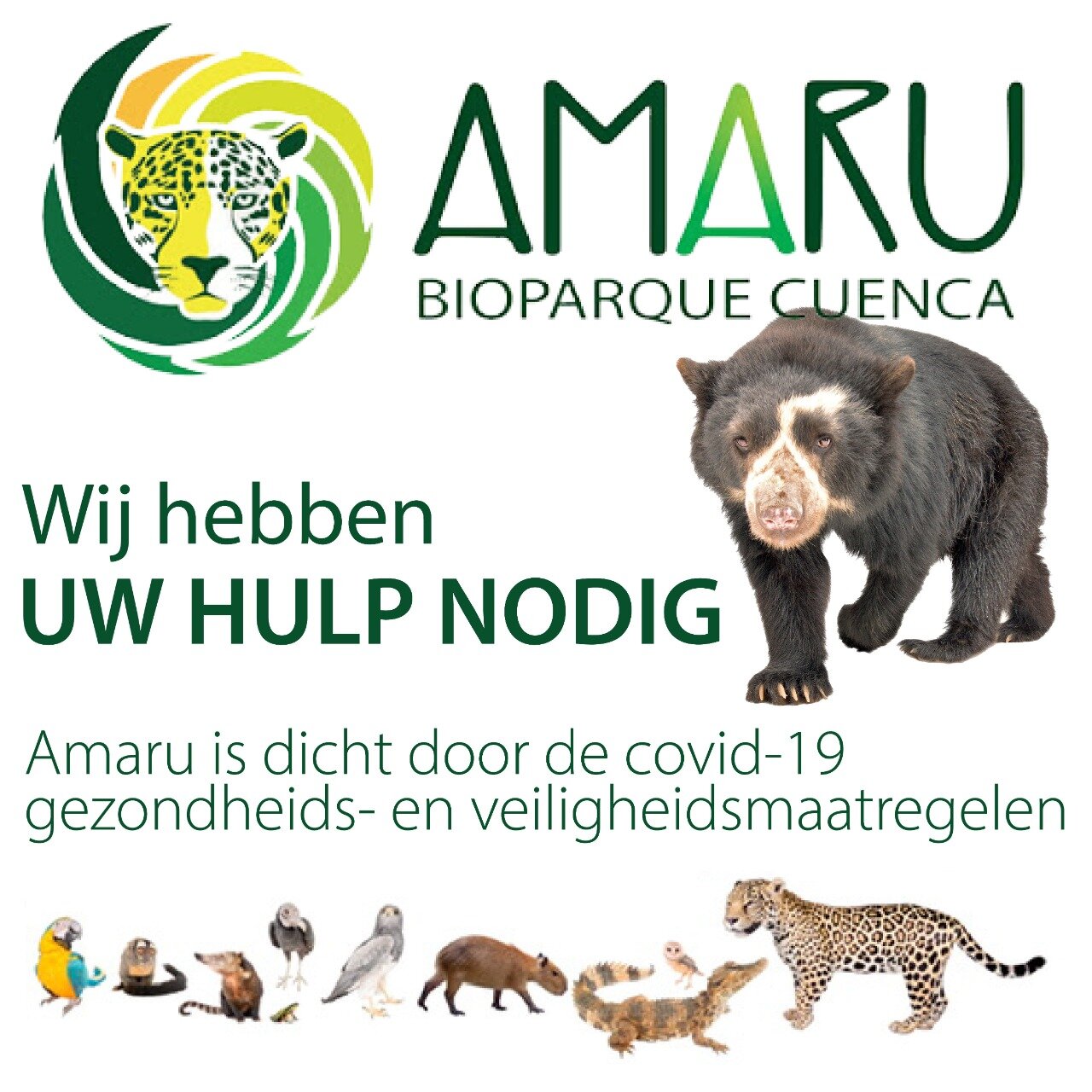
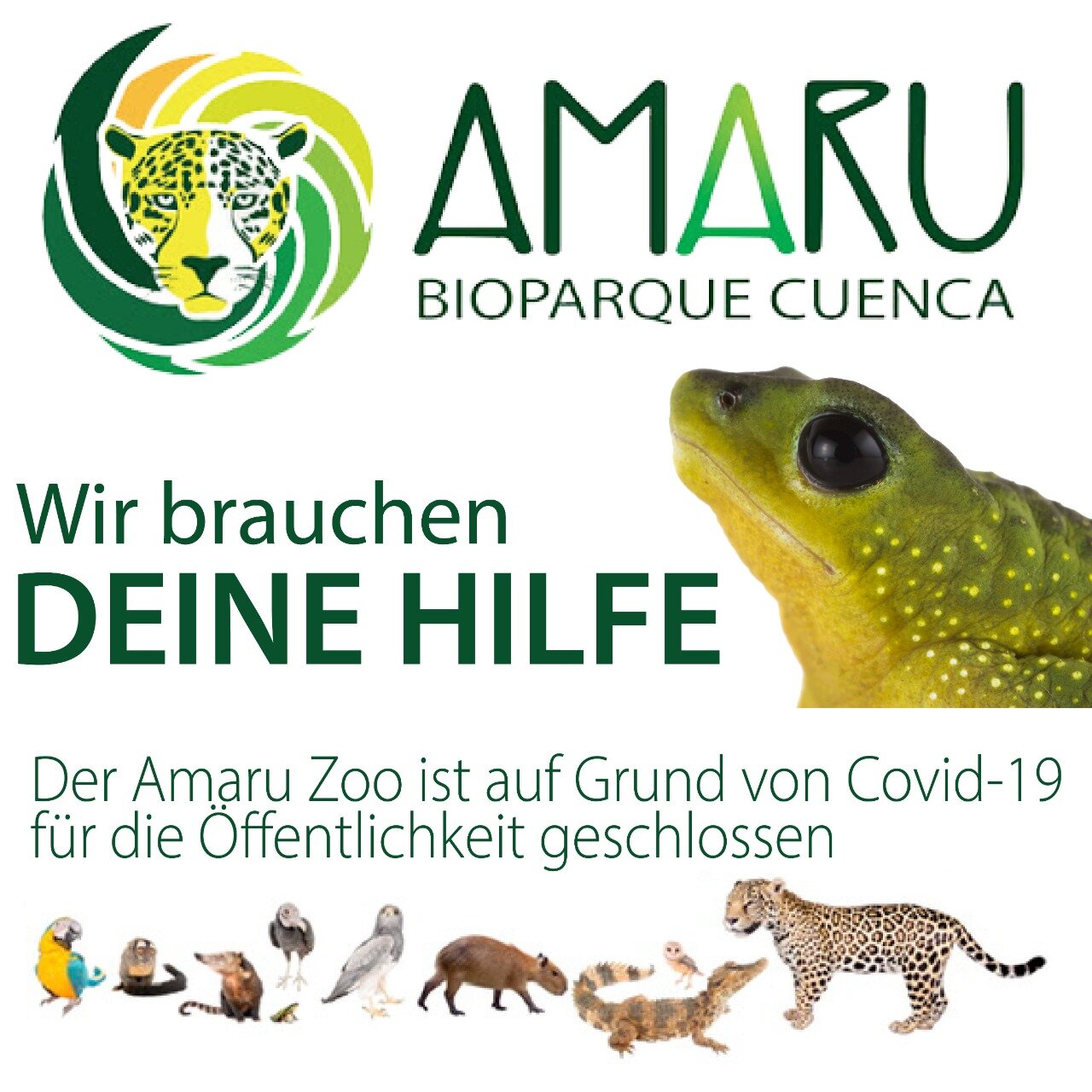
The Bioparque Amarú in the city of Cuenca is a family business run by the Arbeláez Ortiz family, which seeks the conservation and education of the wildlife found in the southern region of Ecuador. As of this year, 2020, the park has guaranteed the protection of approximately 1,200 animals, an activity that generates a livelihood for forty park employees and their respective families. Many of these families are neighbors of the area where it is located, Rayoloma, to the south of the city. The park stays operational with box-office revenue as its main source of funding. This is why, in the current context, it represents a precarious decision for Amarú to close its doors to the public and, with that, the resources that sustain the place. Since the social isolation provisions are generic, a wildlife park under social isolation is not the same as other kinds of spaces. For an office business, stopping activities due to social distancing means sending its employees to work from home. What happens is that, at Amarú, the animals will keep eating and roaming the park; its facilities must be continuously maintained, and the veterinary costs and salaries for the employees who provide all these services are unavoidable. To keep this animal rescue center running during a pandemic, the necessary resources are costly.
Two weeks ago, I spoke with Victoria Arbeláez; she is the founder and administrator of Amarú Park. Her opinions were forceful regarding the needs they have at the park. Approximately USD 36,000 are needed each month to care for and feed all the animals. The situation of this park—but, in general, of all the animal centers in the country—hangs on the capacity of our society to support one another and rise together. They have currently managed the crisis through donations of perishable agricultural products. From a poultry company, they arrange for chickens that cannot be sold to feed reptiles, birds, and small mammals. From the city's supermarkets, surpluses of fruits and vegetables not fit for the shelves are delivered, and with these they feed all kinds of herbivores. Finally, from the nearby ranches and farms, they arrange for cows or horses that have died from natural causes to be donated to feed large felines.
All these valuable resources are limited to the capacity to generate empathy among businesses and people in the city. Being already in the second month of isolation—and perhaps some more in this condition—the resources that will have to keep coming in are crystal clear, and the empathy cannot dwindle.
The conversation led us to try to envision the park's capacity to generate additional projects that bring in resources. Both Victoria and the entire park are aware of the technological barriers and the limited resources of our society, which is why their new initiatives are worth mentioning. There will be donation campaigns—crowdfunding, in English—open to the support of virtually everyone (link). They hope to open a new digital service called "Amarú va a tu casa" (Amarú comes to your home), where, through a small contribution, you can have an educational video call with animals. Efforts are being made so that school and high school students who were supposed to visit the park this academic year can do so digitally, in order not to lose academic funding. There are plans to create memberships and animal sponsorships from universities, businesses, and the general public.
At Amarú, all assistance will always be welcome; perhaps if each one of us makes an effort to support the park's work, its needs will gradually be met. I myself got excited about this idea, and a couple of weeks ago I was able to collect a box of apples from a personal orchard to donate to the park. I must confess that I initially found myself electrified to support this park's efforts. However, talking with Victoria allows me to see a somewhat bitter reality. The amount of resources that an animal park truly needs is very large, so much so that, despite personal support like a box of apples, it turns out to be insignificant. Let's join collective efforts, let's focus our greatest interest on achieving transcendental changes. Every apple counts.
If a phenomenon as radical as the coronavirus came to change the way we think as humanity, believing that our actions in the world will make a great change in society may perhaps be a mental absurdity. What happens is that a minimal action—like supporting the efforts of a park that seeks the protection of wildlife despite its limited resources—is worthwhile. But our greatest effort must be to ensure that the projects Victoria mentioned to me are the ones that generate the greatest returns to save the park, with the best it has to offer, which is being a park.
The paradox of thinking about paradigm shifts toward the "new normal" is repeated in both theory and practice. Just as it is normal to consider a planet condemned to the exploitation, destruction, and mass extinction of nature. Just as it is normal to have a society consumed by the banality of scandals of all kinds, wars, hunger, and violence. Whoever has in their hands or nearby (I assume most of us will) a smartphone, computer, radio, or TV instantly becomes a spectator and, at the same time, an author of this crisis. We have seen and heard one event after another, most of them a consequence of this tragedy, but many the result of our chaotic legacy as a society, even without the arrival of the coronavirus. Each person must conceive of the problem and its solutions; ideas start at home and will soon move to the city, as well as to every outside space. Let us be the architects of a new normal in which we think before acting, in which we lend each other a hand between collectives and individuals.
Throughout past pandemics, these catastrophes managed to set in motion a general reengineering within societies. The need created by living under the fear of a new disease is always the doorway to innovation. Changes in public health are closely linked to changes in urban planning and the design of new built environments. I invite everyone to begin tomorrow—the day the confinement ends—with a spirit of personal and communal ingenuity. It is not enough to long for the old normal; it is time to set out on an agile and innovative experimentation, the will to break with the frameworks of the past and to foster creativity for the good of humanity and the planet.
References:
AMARU webpage: www.zoobioparqueamaru.com
Interview: Eng. Victoria Arbeláez, Administrative Director, Amarú Bioparque Cuenca